




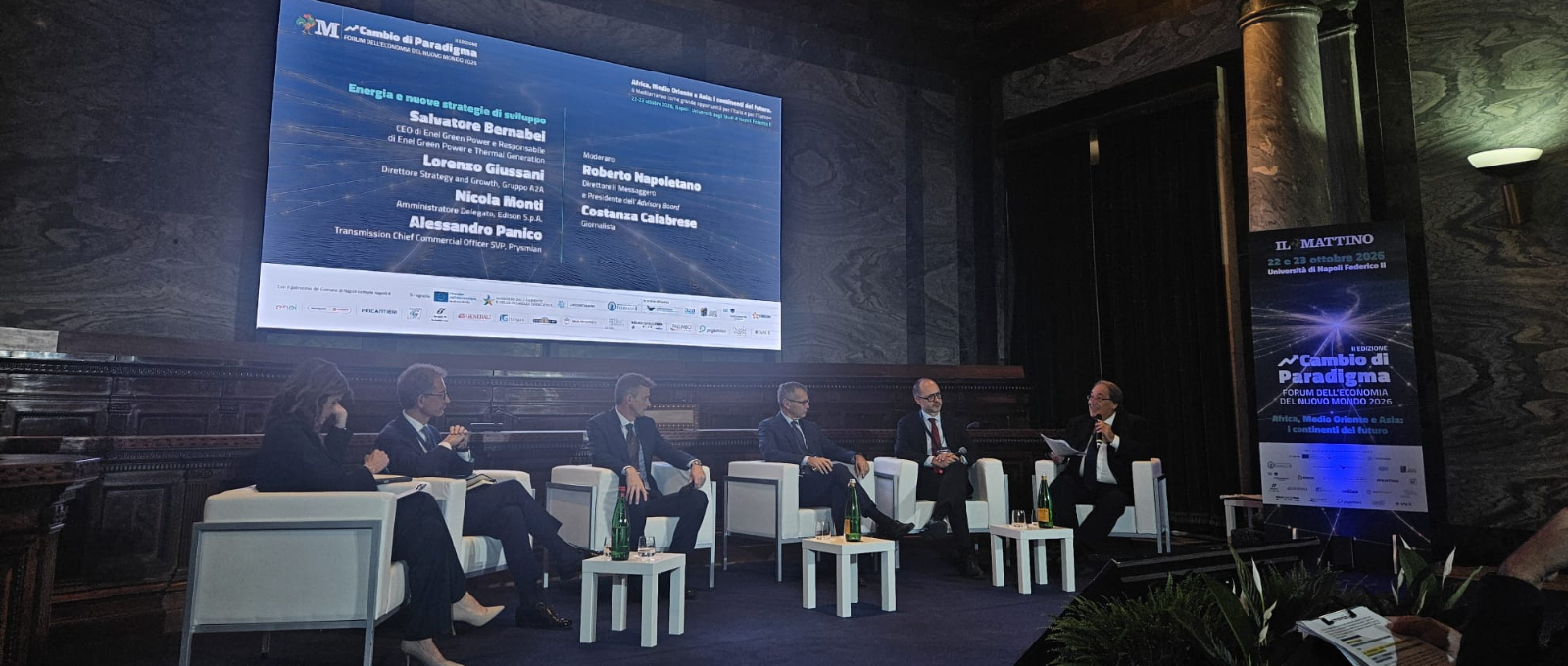
The strategic role of Southern Italy in strengthening Europe's energy security, advancing large- scale interconnections and supporting the growth of AI-enabled digital infrastructure was the focus of an address by Alessandro Panico, Prysmian Transmission Chief Commercial Officer SVP, during the panel discussion "Energy and Energy Security" held as part of the second edition of Cambio di Paradigma – Forum dell’Economia del Nuovo Mondo, promoted by Il Mattino in Naples.
Panico: "Southern Italy is not only a key energy reserve for the country, but also a strategic hub in the Mediterranean, thanks to its geographical position and its growing role in international energy flows. Prysmian is contributing to this transformation through its plant in Arco Felice, one of the world's leading manufacturing sites for high-voltage submarine cables. From here, we deliver infrastructure that connects continents and strengthens global energy security. In Arco Felice plant we will manufacture the cables for the enhancement of New Zealand's Cook Strait HVDC link, as well as for the new electricity and telecommunications interconnection between Victoria and Tasmania in Australia."
Panico: "Energy interconnections also require advanced monitoring and protection capabilities. In Palermo, more than forty of our engineers develop software and systems dedicated to monitoring critical infrastructure, helping make it increasingly secure, reliable and resilient. Ensuring the security of energy corridors will become an ever more important element of tomorrow's power networks."
Panico: "Artificial intelligence is driving unprecedented growth in demand from data centers and, as a result, increasing the need for power transmission infrastructure. Meeting this demand requires not only more advanced networks, but also technologies that can make them more efficient. Today, we operate a fleet of thirteen cable-laying vessels active across the globe, which we monitor in real time both on board and from our control rooms in our headquarter. AI is becoming a fundamental enabler of greater operational efficiency, competitiveness and infrastructure performance. The challenge is not only to build new networks, but to ensure they remain affordable over the long term. Technology, digitalization and innovation must serve as enablers of infrastructure that is increasingly reliable, resilient and capable of supporting economic growth and the energy transition."